Articles · History of astrology
The Munich School: Wolfgang Döbereiner and the astrology of life's rhythms
Origins, ideas, seven-year rhythms and works of the Münchner Rhythmenlehre, one of the most original currents of twentieth-century European astrology.
Introduction: when astrology becomes a reading of time
There are astrological traditions that describe character through the position of the planets at birth. Others look at transits, progressions and the configurations that accompany the changes of life.
The Munich School, in German Münchner Rhythmenlehre (MRL), "the Munich doctrine of rhythms", puts time at the centre. Its founder, the German astrologer Wolfgang Döbereiner (1928–2014), made it an interpretive system with rules of its own, in which the themes of events return again and again over time according to precise rhythms.
The best-known element of the school is the seven-year rhythm, which links every house of the chart to a period of seven years. But the MRL also includes other techniques, a very extensive literature and an original astrological reading of homeopathy.
1. Wolfgang Döbereiner
Wolfgang Döbereiner was born on 28 February 1928 in Munich and died on 5 April 2014 in Herrsching, on the Ammersee. He was the grandson of the court musician Christian Döbereiner.
As a boy, during the Second World War, he was called up as an anti-aircraft auxiliary and was taken prisoner by the Americans, from whom he managed to escape shortly afterwards. In 1947 he took his school-leaving exam and studied music.
For years he worked as a consulting astrologer and music teacher. According to what he himself declared, it was in that period that he developed the Münchner Rhythmenlehre (1953): his first writings on the method date from the years 1953–1957.
In the 1970s he founded his own school of astrology in Munich. In 1971 he began an evening course, the transcripts of which were published as Astrologischer Lehr- und Übungskurs (1971–1974) and then as Astrologisches Lehr- und Übungsbuch, in six volumes. He also became known for his newspaper publications, for his weather forecasts and for the astrological interpretation of the images of homeopathic remedies.
In the obituary published by Astrodienst in April 2014 he is remembered as the teacher of several astrologers who are well known today, a figure who divided opinion: you either loved him or rejected him.
2. An astrology "after the classical"
Döbereiner believed that he had radically modernised astrology, making it a closed and coherent interpretive system, which he understood as an "overcoming of the classical" (Ablösung der Klassik).
An essential element of his doctrine is the link between astrology, psychosomatic aspects and homeopathy, which he presented as a renewal of the ancient doctrine of signatures: the idea that precise substances or plants correspond to planets and constellations.
The most characteristic principle is that of the enlarged rhythms (vergrößerte Rhythmen), in particular the rhythm of seven and that of ten years. According to this idea, the themes of events repeat in rhythms, as identical contents at different moments of life.
3. The seven-year rhythm
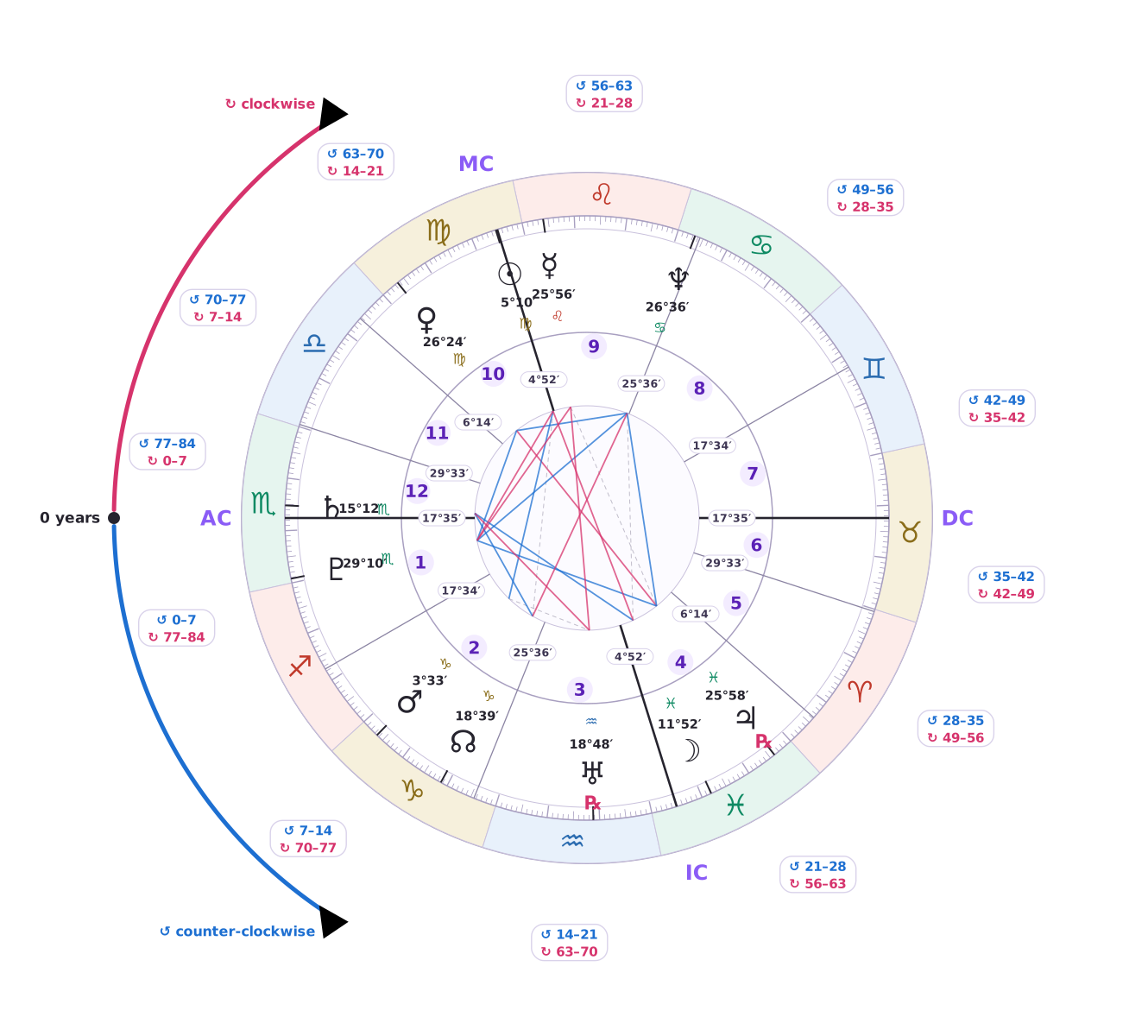
The best-known technique of the school associates a period of seven years with every house of the chart. One starts from the Ascendant, where one is at 0 years, and passes through the twelve houses, for a total of 84 years. When the path passes from one house to another, the phase of life changes.
The cycle of the seven-year rhythm · 84 years, 12 houses × 7 years
- Phase 10–7 years
- Phase 27–14 years
- Phase 314–21 years
- Phase 421–28 years
- Phase 528–35 years
- Phase 635–42 years
- Phase 742–49 years
- Phase 849–56 years
- Phase 956–63 years
- Phase 1063–70 years
- Phase 1170–77 years
- Phase 1277–84 years
The twelve phases pass through the houses in a different order depending on the direction in which the chart is traversed, as the figure below shows.
The two directions of travel
The chart can be traversed in two directions, both starting from the Ascendant.
- The counter-clockwise direction is called Phänomenrhythmus: from the Ascendant one proceeds through the first house, then the second and so on. In a discussion on an astrology forum it is described as the rhythm of what happens to the person.
- The clockwise direction is called Fügungsrhythmus: from the Ascendant one proceeds through the twelfth house up to its cusp, where one is at 7 years, then the eleventh (14 years) and so on up to the cusp of the first house (84 years). In the same discussion it is described as the rhythm that tells the why.
4. How an activation is calculated
The method does not stop at assigning seven years to each house. The width of a house, in degrees, is divided by the seven years, so as to know at which moment the path reaches a planet or another point. If a house measures 28°, the path advances by 4° a year; a Moon at the 3rd degree of the house is reached after about nine months. Placidus houses are used for these calculations.
When the path touches a planet, a cusp or a significant point, the school speaks of activation (Auslösung). Each phase is also governed by a planet, the Phasenherrscher ("phase ruler"): it is the planet that rules the sign on the cusp of the house at the beginning of the phase, and its moment of activation is calculated from the distance from the cusp.
Döbereiner also linked signs and planets to the different rhythms: for example the ten-year rhythm to Leo and the Sun, the seven-year one to Cancer and the Moon.
This is a symbolic procedure: there is no scientific proof that it allows events to be predicted.
5. The Septare
The Septare are "sub-charts" (Unterhoroskope) in which the rhythm is no longer seven years per house but seven twelfths of a year, that is seven months per house.
6. Other developments of the method
Over the years the school has produced other techniques and a series of seminars. The Astrodienst obituary recalls among his contributions the "doctrine of the back" or "of the gaps" (Rückseiten- oder Lückenlehre) and the Weg der Aphrodite, the "path of Aphrodite", born from seminars held in Fischerhude in 1988 and published in 1990 as volume 10 of the Flumserberger Seminare.
Since 1990 the Seminare of the Münchner Rhythmenlehre have appeared: among the titles, Das Gleichnis des Elefanten (vol. 1), Die verlorene Grenze (vol. 15), In der Gewalt der Titanen (vol. 16) and Der König kehrt zurück (vol. 19).
7. Astrology and homeopathy
Döbereiner worked for a long time on the astrological interpretation of homeopathic remedies. The work appeared as Astrologisch-medizinische Diagnose und Homöopathie (1980) and, reworked in two volumes, as Astrologisch-homöopathische Erfahrungsbilder zur Diagnose und Therapie von Erkrankungen.
The astrological-homeopathic interpretations belong to the history of symbolic practices and alternative medicines: they are not clinically validated methods of diagnosis or treatment and must not be used in place of a medical assessment.
8. Astrological-geographical maps and art
Among his works there are also Astrologisch-geographische Karten (1994) and a two-volume study of astrologically definable behaviours in painting (Astrologisch definierbare Verhaltensweisen in der Malerei, 1988).
9. The main works
The literature of the school is largely in German. Some works also exist in English (Textbook of Astrology, volumes I–III, and Patterns of Experience, volume I); in French there are a few lectures.
- Horoskop für jeden Tag. Ein astrologischer Lebensfahrplan, Südwest, Munich 1972 (ISBN 978-3-517-00396-2).
- Astrologischer Lehr- und Übungskurs, Hugendubel, Munich 1974 (evening course 1971–1974); new edition as Astrologisches Lehr- und Übungsbuch, six volumes, from 1978.
- Der Wandel des Lebens im Tierkreis, Verlag Döbereiner, Herrsching 2006: revised edition of the twelve booklets on the signs of the zodiac published in 1974 (ISBN 978-3-927094-40-6).
- Weg der Aphrodite, Flumserberger Seminare, volume 10, Munich 1990 (ISBN 978-3-927094-09-3).
- In der Gewalt der Titanen, Seminare, Herrsching 2001 (ISBN 978-3-927094-37-6).
10. The Munich School today
Döbereiner's books and seminars continue to be published by his publishing house, Verlag Döbereiner, in Herrsching on the Ammersee: in the catalogue of the Deutsche Nationalbibliothek there appear volumes of the series Münchner Rhythmenlehre – Seminare published up to 2026.
The Astrodienst obituary tells that for Döbereiner the doctrine of rhythms was "a means of living", and that the conflicts arose from those who wanted to declare it the one absolute truth.
11. The Munich School between symbolism and science
The Münchner Rhythmenlehre is an elaborate and original system from the historical and cultural point of view, but it is not a scientifically demonstrated theory. There is no solid scientific proof that the seven- or ten-year rhythms allow individual events to be predicted reliably.
Its study has value as knowledge of an interpretive tradition, as a chapter in the history of contemporary astrology and as a reflection on the meaning of time and experience.
The Munich School in AstraAgorà
AstraAgorà, free and with no sign-up, sets your chart beside seven schools, and the Munich School is the first. It offers a reading inspired by the method, with original texts and not a reproduction of Döbereiner's work: planets as functions, signs as principles, houses as fields of life, house rulers that link the fields, the Sun–Moon–Ascendant triad, the Sun–Moon rhythm, mirrors (antiscia) and midpoints, up to an overall portrait. The rhythmic activation techniques described in this article, such as the seven-year rhythm and the Septare, are not included. The same chart can also be read with the cosmobiology of Reinhold Ebertin and with psychological astrology.
Sources consulted
- Wolfgang Döbereiner, German Wikipedia: biography, principles of the doctrine, list of works.
- Deutsche Nationalbibliothek: titles, years, ISBNs and publisher (Herrsching).
- Loop! Astrologie-Zeitung (Astrodienst), «Diese kosmische Spur der Wahrheit», April 2014: obituary.
- Chiron Verlag, «Der Siebener-Rhythmus im Horoskop»: the "phase ruler" and the calculation of the activation.
- Discussion «Münchner Rhythmenlehre, zeitliche Auslösungen» on the astrologisch.eu forum: the two directions of travel, the Septare, the calculation example. It is a study forum, therefore a secondary source.
- Johann Wolfgang von Goethe, Aus meinem Leben. Dichtung und Wahrheit, book I: date and time of birth.