Articles · Vedic astrology
Vedic astrology: origins, principles, schools and essential books on Jyotish
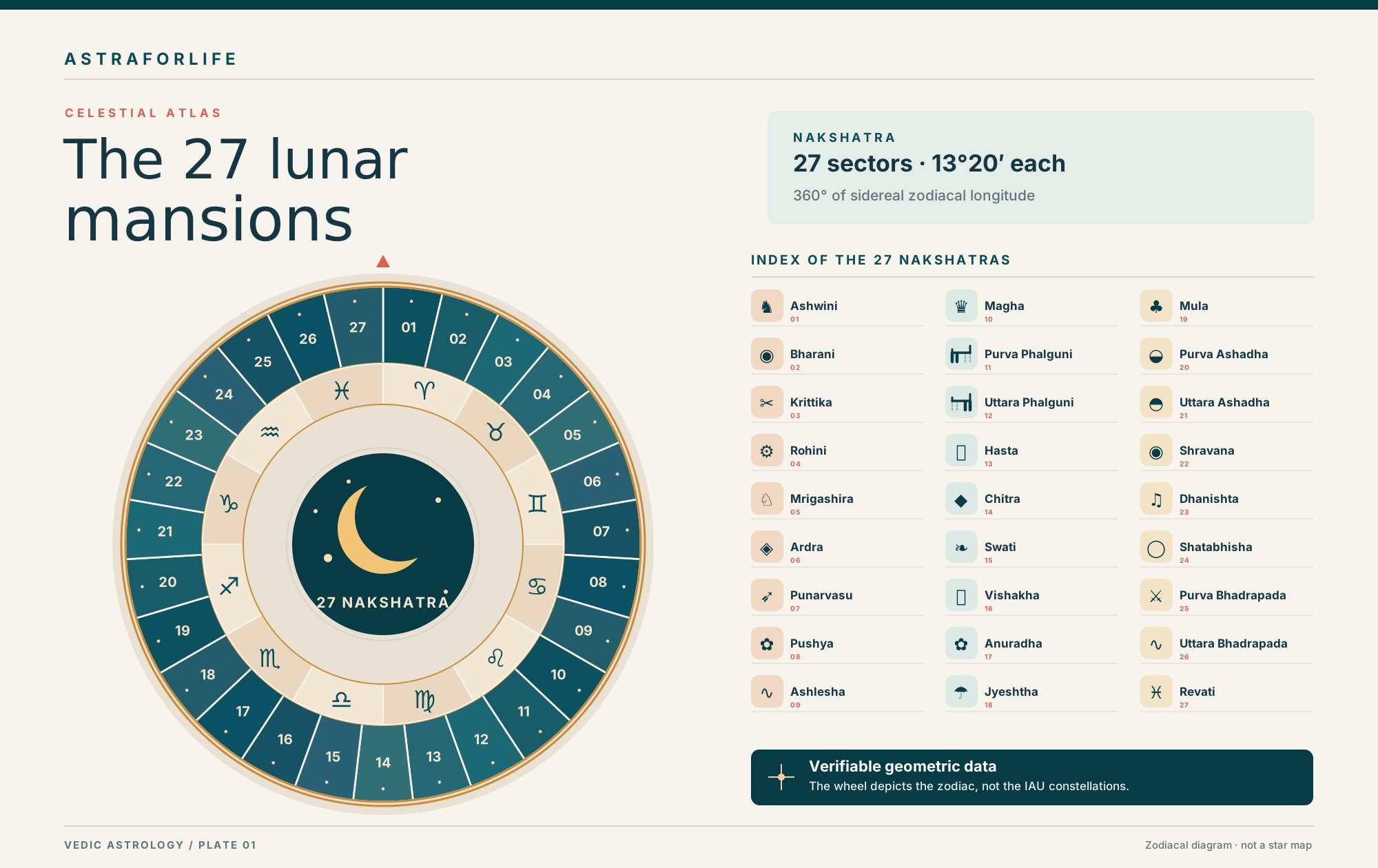
The 27 lunar mansions: a zodiacal diagram, not a star map. The 27 sectors measure 13°20′ each.
A journey into the astrological tradition of India, between knowledge of the sky, the symbolism of the planets, the philosophy of karma and contemporary interpretations.
Vedic astrology, also known as Jyotish or Jyotiṣa, is one of the most important astrological traditions of India. Its history runs through centuries of astronomical observation, philosophical elaboration, ritual practice and systems for interpreting human life.
The Sanskrit term Jyotish recalls the knowledge of the celestial lights: the Sun, the Moon, the planets and the stars. In the Indian tradition these lights take on a meaning that goes beyond their physical presence in the sky, becoming symbols through which to interpret time, the cycles of existence and the relationship between the individual and the universe.
Studying Vedic astrology therefore means approaching an articulated discipline, which includes several schools, classical texts, methods of calculation and interpretations.
But what really distinguishes Jyotish from Western astrology? What are its fundamental concepts? And which authors and works allow it to be studied seriously?
1. The origins of Vedic astrology
The roots of Jyotish lie in the religious and intellectual culture of ancient India. The discipline is traditionally counted among the six Vedangas, the auxiliary branches of knowledge used for the study and correct application of the Vedas.
In one of its oldest forms, Jyotish was above all tied to the measurement of time, the definition of the calendar and the identification of the right moments for ritual ceremonies.
The Vedanga Jyotisha, traditionally attributed to Lagadha, is an important document of this early phase.
It is necessary, however, to distinguish the ancient calendrical knowledge from the later horoscopic astrology. The latter developed through a long process of transformation and encounter between Indian, Mesopotamian and Hellenistic traditions.
For this reason, contemporary Vedic astrology should not be understood as a system that has remained identical for thousands of years, but as a living tradition, enriched by influences, commentaries and innovations.
2. The three great areas of Jyotish
In the traditional classification, Indian astrological knowledge comprises three great fields.
Siddhanta or Ganita — astronomical calculation
It includes the mathematical study of celestial movements, planetary positions, coordinates and systems of measuring time. It forms the technical foundation of traditional astrological calculations.
Hora — horoscopic astrology
It deals with the interpretation of astrological charts, in particular the birth chart, planetary configurations and the periods of life according to the rules of the tradition.
Samhita — collective and natural astrology
It collects traditional interpretations of natural phenomena, omens, weather conditions and events concerning communities and kingdoms.
This division shows that Jyotish, historically, was not limited to reading individual personality, but had a much wider function in Indian society.
3. The fundamental concepts of Vedic astrology
The sidereal zodiac
One of the best-known differences between modern Western astrology and Vedic astrology concerns the zodiac.
Most contemporary Western astrology uses the tropical zodiac, referred to the point of the spring equinox.
Jyotish, instead, mainly uses the sidereal zodiac, calculated with respect to stellar references.
The angular difference between the two systems is called ayanamsha. Its value changes slowly over time because of the precession of the equinoxes, and also varies slightly according to the method adopted.
This means that a person considered an Aries in tropical astrology might have the Sun in Pisces in the sidereal system.
The difference does not necessarily indicate an error: the two systems use different zodiacal references.
The nine Grahas: planetary forces
In the Indian astrological tradition the nine Grahas are fundamental, interpreted symbolically as principles that take part in the reading of human experience.
| Graha | Traditional symbolic meaning |
|---|---|
| Surya — Sun | Identity, authority, vitality |
| Chandra — Moon | Mind, emotions, sensitivity |
| Mangala — Mars | Action, courage, initiative |
| Budha — Mercury | Intellect, language, trade |
| Guru — Jupiter | Wisdom, teaching, expansion |
| Shukra — Venus | Beauty, pleasure, relationships |
| Shani — Saturn | Responsibility, limits, discipline |
| Rahu — lunar North Node | Desire, ambition, unconventional experiences |
| Ketu — lunar South Node | Detachment, inwardness, liberation |
Rahu and Ketu are not physical planets: they correspond to the nodes of the lunar orbit, astronomical points associated with the geometry of eclipses.
The twelve Rashis and the twelve Bhavas
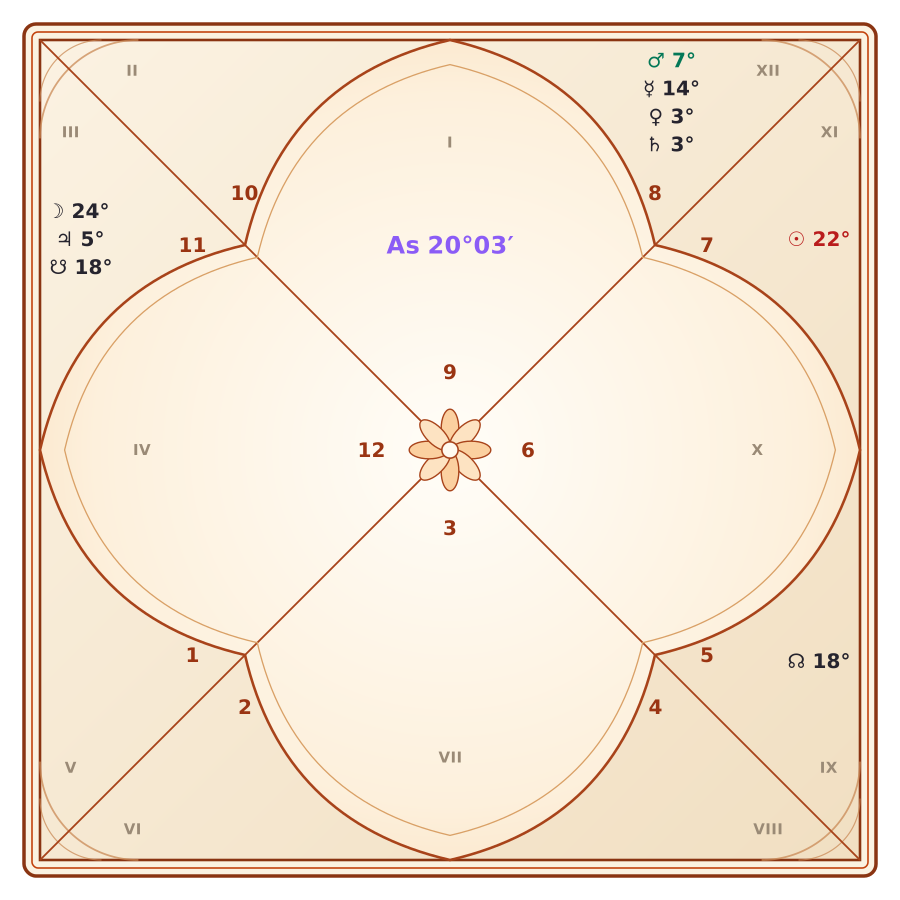
The Rashis are the twelve zodiac signs, while the Bhavas are the twelve astrological houses.
In the traditional reading, the houses represent different spheres of existence: identity, resources, communication, family, creativity, work, relationships, transformations, knowledge, profession, community and inner life.
Interpretation arises from the relationship between signs, houses, planets, rulers and aspects, according to the specific rules of the school followed.
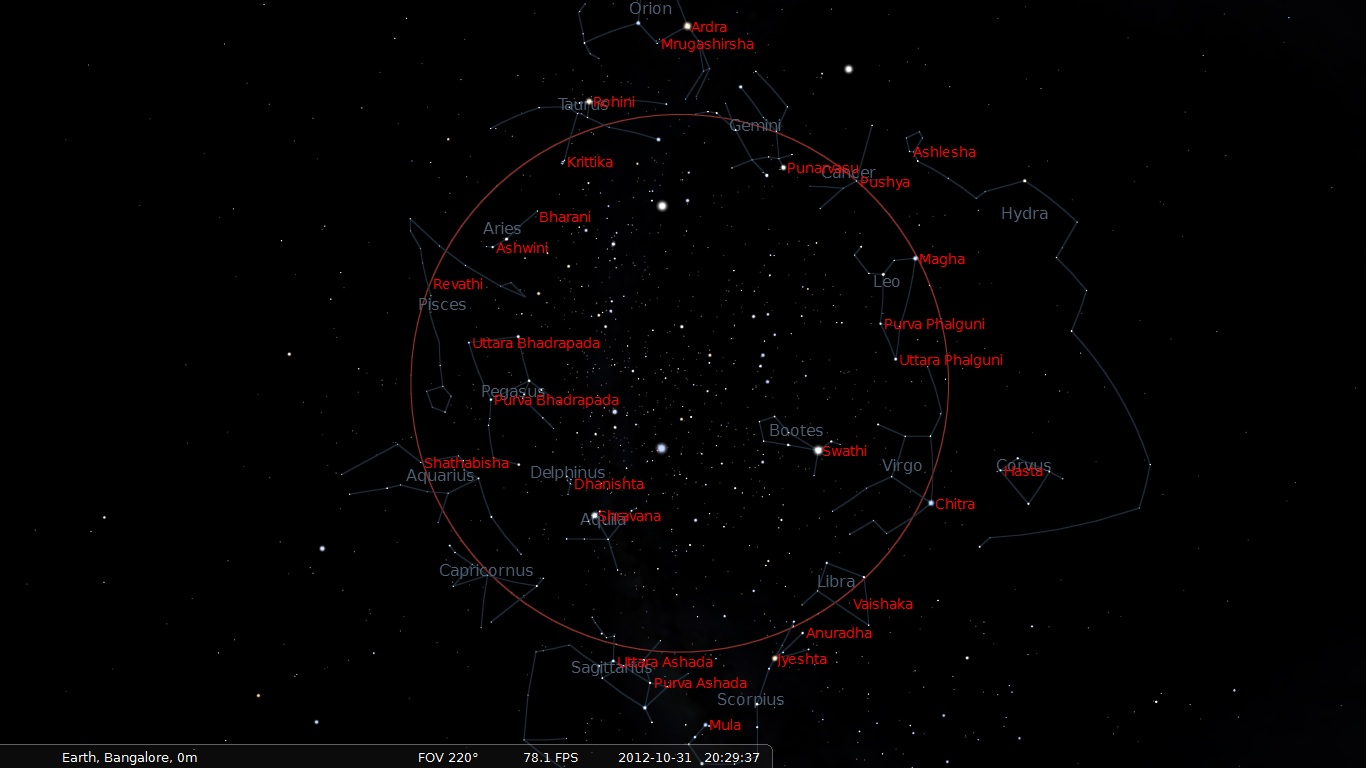
The 27 Nakshatras: the lunar mansions
A particularly characteristic element of Jyotish is the system of the 27 Nakshatras, the lunar mansions that ideally divide the ecliptic into 27 sectors of 13°20′ each.
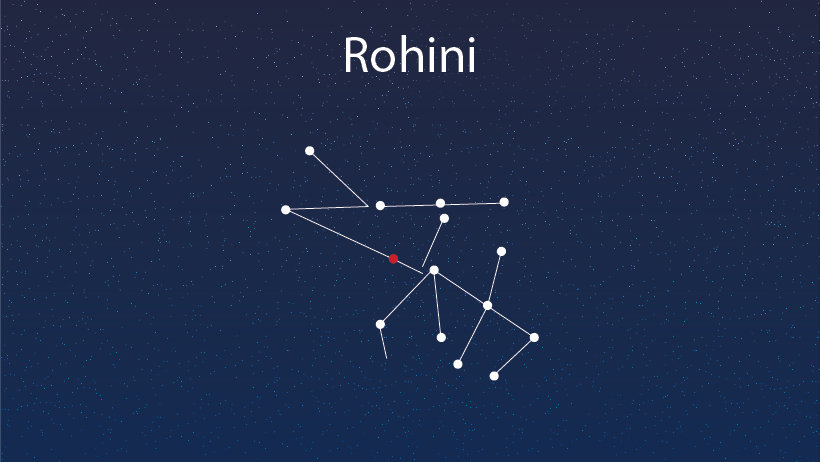
Each Nakshatra has a name, a deity associated with it in the tradition, symbolic qualities and a planetary ruler.
The position of the Moon in one of these sectors is of particular importance in astrological reading and in the traditional systems of dividing time.
The Nakshatras are one of the most recognisable components of India's astronomical and symbolic heritage.
Every day the Moon changes nakshatra, and AstraSky shows the current one, with the pada and the time at which it ends.
The Dasha: the planetary cycles of life
Jyotish attaches great importance to time.
The Dashas are systems of periodisation through which traditional astrologers interpret the succession of the different phases of life.
Among the most widely used is the Vimshottari Dasha, which organises an overall symbolic cycle of 120 years, divided among nine planetary rulers.
The astrologer interprets these periods in relation to the birth chart, the positions of the planets and the sub-periods.
The Dasha is one of the tools that most distinguishes the Vedic approach from the more common forms of Western astrology.
The Vimshottari, with its sub-periods, is calculated in AstraAgorà starting from the nakshatra of the Moon.
Karma and Dharma
Indian astrological thought has often been linked to two fundamental ideas of India's religious philosophy:
Karma, understood as action and consequence, and Dharma, a complex concept that can indicate order, responsibility, duty or the path appropriate to one's condition.
In some contemporary spiritual interpretations, the birth chart is read as a symbolic representation of the individual's tendencies, responsibilities and paths of growth.
This does not mean that every event is necessarily predetermined. Even within the tradition there are different interpretations of the relationship between destiny, action and personal freedom.
4. The main schools of Vedic astrology
Vedic astrology is not a uniform discipline. Over the course of its history different methods of interpretation have emerged, each with its own rules, sources and techniques.
It is important to distinguish the traditional schools from the modern methods, developed above all between the nineteenth and twentieth centuries.
The Parashari school
The Parashari tradition, associated with the sage Parashara, is one of the most influential orientations of contemporary Jyotish.
Its main reference is the Brihat Parashara Hora Shastra, a collection of astrological teachings attributed by tradition to Parashara, but whose textual history and dating remain a matter of discussion.
This system pays great attention to the planets, the houses, their rulers, the Yogas (planetary configurations), the Dashas and the divisional charts, such as the Navamsha.
It is an important point of reference for those who wish to learn the classical interpretation of the birth chart.
The Jaimini school
The Jaimini tradition, associated with the Jaimini Sutras or Upadesha Sutras, proposes a set of techniques that differ from those commonly used in the Parashari approach.
A significant feature is the use of the Chara Karakas, variable significators determined by the zodiacal positions of the planets.
The Jaimini school also employs particular systems of periodisation, including the Chara Dasha, and interpretive methods based on the signs.
These tools are often studied in parallel with the Parashari ones, especially in advanced training courses.
The Nadi tradition
The term Nadi Jyotish indicates several Indian astrological traditions, some of them linked to the literature of manuscripts and to the transmission of specific teachings.
In some forms of Nadi, particular planetary combinations, interpretive sequences and techniques of prediction are used.
It is necessary to distinguish documented astrological methods from the claims, found in some commercial practices, that there are manuscripts containing the personal destiny of every individual. The latter are not scientifically proven.
5. The modern schools and contemporary evolution
In the twentieth century Indian astrology saw new forms of systematisation and international diffusion.
B. V. Raman and the spread of modern Jyotish
B. V. Raman was an important figure in popularising Indian astrology in English. Through books, teaching and editorial activity he helped make its classical methods more accessible, with particular attention to the systematic reading of horoscopes.
K. N. Rao and teaching through case studies
K. N. Rao is associated with a didactic approach centred on the comparative analysis of astrological charts, the study of the Dashas and the internal verification of the rules of the tradition through practical examples. His texts are also part of Indian training programmes.
Krishnamurti Paddhati — the KP system
Developed by K. S. Krishnamurti in the twentieth century, the KP method proposes a particularly detailed subdivision of the Nakshatras and gives great importance to the sub-lords, the rulers of their further sections.
It also uses a house system based on cusps, traditionally Placidus. It is one of the most recognisable methodological innovations of modern Indian astrology.
Contemporary psychological and spiritual interpretations
In recent decades, above all through the international diffusion of Jyotish, approaches have emerged that pay greater attention to the introspective dimension.
In these readings, the planets are interpreted as symbolic representations of attitudes, potentials, inner conflicts and paths of development.
These perspectives do not necessarily constitute a unified school, but they bear witness to the capacity of the Indian astrological tradition to dialogue with contemporary sensibilities.
They are, however, symbolic interpretations and not clinically validated psychological assessments.
6. The essential books for studying Vedic astrology
Those who wish to understand Jyotish in depth should combine the study of the classical works with introductory modern texts, commentaries and historical research.
Brihat Parashara Hora Shastra — attributed to Parashara
A central reference for the Parashari tradition. It deals with planets, houses, Yogas, Dashas and predictive techniques. The dating and the history of the different recensions are complex and debated.
Brihat Jataka — Varahamihira
A classical work of the sixth century, fundamental for the history of Indian horoscopic astrology and for understanding the systematisation of the interpretive rules.
Phaladeepika — Mantreswara
A traditional treatise much studied for the interpretation of the houses, of planetary combinations and of astrological periods.
Light on Life: An Introduction to the Astrology of India — Hart de Fouw and Robert Svoboda
One of the most complete modern introductions, particularly suited to Western readers. It addresses the philosophy of Jyotish, the astronomical principles and the reading of the birth chart.
How to Judge a Horoscope — B. V. Raman
A modern reference text for developing an orderly method of interpreting the twelve astrological houses, through explanations and examples.
Other texts that deserve attention are the Saravali of Kalyana Varma, the Jataka Parijata of Vaidyanatha and the Jaimini Sutras.
For a particularly rigorous historical and academic study, Jyotihsastra: Astral and Mathematical Literature by David Pingree is also useful.
7. How Jyotish is studied today
A serious course of training requires more than the simple memorisation of planetary meanings.
It is useful to begin with the astronomical foundations: understanding the sidereal zodiac, the coordinates, the Ascendant, the houses and the Nakshatras. Only afterwards is it worth tackling the rules of interpretation, the Yogas, the divisional charts and the Dasha systems.
Reading the classical texts is an important step, but it must be accompanied by the awareness that translations can differ and that some sources have reached us through later recensions and commentaries.
Comparing different schools also makes it possible to recognise which principles are shared and which instead belong to specific teaching traditions.
8. Vedic astrology and scientific knowledge
Jyotish occupies an important place in the cultural, religious and intellectual history of India. But it is necessary to distinguish its historical and symbolic dimension from claims about the ability to predict personal events.
The positions of the celestial bodies can be calculated scientifically, whereas there is no solid scientific proof that astrological configurations determine personality or allow reliable predictions about individual destiny.
This does not prevent the study of astrology as a symbolic language, a philosophical tradition, a cultural heritage or a personal tool for reflection.
A balanced perspective makes it possible to appreciate the richness of Jyotish without confusing symbolism, faith, history and science.
9. Conclusion: the cultural value of Jyotish
Vedic astrology is a universe of knowledge, interpretations and traditions that continues to arouse interest even outside India.
From the ancient observations of the sky to the treatises of Varahamihira, from the Parashari tradition to the innovations of the Krishnamurti method, Jyotish shows how a discipline can pass through different eras while keeping a recognisable identity and, at the same time, transforming itself.
Its study invites reflection on universal themes: time, change, the relationship between action and consequence, the search for meaning and the place of the human being in the cosmos.
For AstraForLife, deepening this tradition means opening a space of knowledge in which culture, history, spirituality and critical thinking can meet.
Jyotish in the AstraForLife apps
The AstraForLife apps use the sidereal zodiac with the Lahiri ayanamsha, the mean nodes for Rahu and Ketu and whole-sign houses, as in the Parashari tradition. Three of them are free and need no sign-up.
AstraSky: the Vedic sky right now
AstraSky shows the sky of this moment in North and South Indian charts, with the nine grahas, the nakshatra and the pada, dignity and combustion. It includes the panchanga, that is the five elements of the Vedic calendar (tithi, nakshatra, yoga, karana and vara) with the time at which each ends, and the chandra bala, the list of lunar birth signs for which today's Moon is favourable. It asks for no data.
AstraYear: the gochara
AstraYear offers the Vedic reading of the year's transits: the transiting planets are counted from the birth Moon, with the favourable houses, the vedha (the obstruction) and the effects in the twelve houses, according to the Phaladeepika (chapter XXVI). It adds the Vimshottari periods of the year and the passage of Saturn over the Moon, the Sade Sati.
AstraAgorà: the Vedic birth chart
The Vedic school of AstraAgorà builds the Indian chart with the dignities of the planets, friendships, directional strength and the aspects of the grahas; the nakshatras with the padas; the twelve bhavas; the main yogas, including the neecha bhanga, that is the cancellation of debilitation; the Navamsha (D9); the Vimshottari periods with the sub-periods and the Sade Sati.
AstraMedica: Jyotisha and Ayurveda
One of the eight schools of AstraMedica, a paid app, reads the chart in a Jyotisha and Ayurveda key: the constitution (prakriti) from the doshas of the signs and grahas, the Lagna and its lord, the houses of illness (sixth, eighth and twelfth), the body in the signs (Kalapurusha) and the Vimshottari periods read for health. It is a tool for study, not a diagnosis, and it does not indicate remedies.
To go further
- Martin Gansten, Astrology, Oxford Bibliographies in Hinduism.
- Audrius Beinorius, The Followers of the Stars: on the Early Sources and Historical Development of Indian Astrology, Acta Orientalia Vilnensia 4 (2003), pp. 119–149.
- Hart de Fouw and Robert Svoboda, Light on Life: An Introduction to the Astrology of India.
- Bharatiya Vidya Bhavan, Jyotish study programmes.